Wells, Fargo
The Crying of Lot 49Wells, Fargo is a private mail carrier in the novel’s layered history of American postal competition. Its riders become the subjects of an 1853 massacre whose uncertain record links the company to the story’s recurring image of secret opposition to official and commercial communication. The episode gives Oedipa a concrete historical clue, but not a settled explanation: the account is thin, its attackers remain unidentified, and its possible connection to Tristero stays conjectural.
Place in Postal History
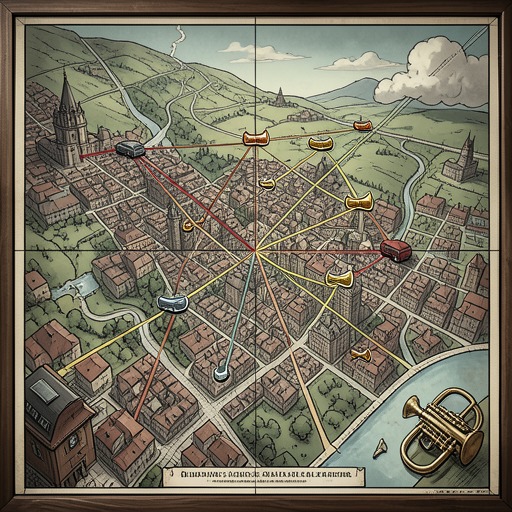
Wells, Fargo belongs to the history of private delivery that Mike Fallopian is researching. His project traces private mail routes in relation to the Civil War and the postal reforms beginning around 1845. Fallopian sees the federal government’s suppression of independent routes as a pattern of power: legislation intended to drive private competition into financial ruin was followed, in 1861, by vigorous action against the routes that had survived. In this account, Wells, Fargo is part of a contested communications landscape in which private carriers operated under pressure from an expanding federal postal system.
The novel later broadens this conflict through Emory Bortz’s account of Tristero’s arrival in America. Bortz says that the postal reforms of around 1845 had already made independent delivery difficult, and that by the 1870s and 1880s private carriers attempting to compete with the government were quickly suppressed. He places Tristero’s American operations in that hostile environment, where the organization’s opposition shifted from the European Thurn and Taxis system to American postal power. Wells, Fargo’s historical role thus sits within a wider struggle over who could carry messages and under what authority.
The 1853 Massacre
A bronze marker at Fangoso Lagoons reports that, in 1853, twelve Wells, Fargo men fought a band of masked marauders in mysterious black uniforms. The marker attributes its account to a post rider described as the massacre’s only witness, who died shortly afterward. It says the attackers’ identities remain unknown. The sole additional clue is a cross traced in the dust by one of the victims.
The marker’s brevity is important to the mystery. It gives Oedipa a number, a place, a date, an appearance for the attackers, and a final trace, but no names or reliable chain of explanation beyond the dead witness. The cross is also ambiguous: Oedipa wonders whether it might instead be the initial T, a shape that recalls a mark in The Courier’s Tragedy. That resemblance prompts her to call Randolph Driblette and ask whether he knew of the Wells, Fargo incident or whether the historical episode had informed his staging of the play’s black-clad bravos. The call goes unanswered, so the parallel remains an investigative question rather than confirmation.
The Company and Tristero
Oedipa’s developing account of Tristero includes the claim that, before 1853, it had appeared in America and fought both the Pony Express and Wells, Fargo. Its agents may have operated as outlaws dressed in black or as messengers disguised as Indigenous people. This account connects the company directly to the conflict Oedipa reads into the Fangoso Lagoons marker, but the narrative presents the connection as part of the accumulating pattern she is trying to interpret, not as independently established company history.
Bortz later supplies a possible explanation for the disguise motif: he says that by 1861 Tristero was training employees in Siouan and Athapascan dialects so that messengers could travel west disguised as Indians. In his telling, impersonation and apparent allegiance helped the organization continue its clandestine opposition after postal reform had narrowed the space for independent carriers. The account makes the earlier report of masked marauders look compatible with Tristero’s methods, but it does not identify the 1853 attackers or demonstrate that they were Tristero members.
Evidence and Significance
Fallopian treats the massacre’s uncertain documentation as a problem of historical knowledge. He has written to Sacramento about the marker, but months of bureaucratic delay have produced no source book. He expects that any eventual account may rely on old-timers’ recollections and notes how difficult it would be to trace such testimony, especially if its author were already dead. His comments sharpen the gap between an official-looking monument and verifiable evidence: the marker preserves a story, yet its source is already beyond reach.
That gap gives Wells, Fargo a narrative function beyond its place in postal history. The company’s riders anchor Oedipa’s suspicions in a specific historical episode, while the marker’s anonymous attackers and ambiguous sign invite the episode to be read as part of a larger underground contest. The evidence permits a connection between the massacre, Tristero, and the black uniforms in the play, but does not resolve whether that connection reflects an actual organization, a chain of transmitted stories, or Oedipa’s increasingly interlinked interpretation of clues.